

Last Updated: October 29, 2026
Quick Summary
Fast turnaround custom screen printing moves your order through artwork approval, screen setup, printing, and shipping on a compressed schedule measured in business days. Rush orders qualify when artwork is press-ready, garments are in stock, and the shop has open press capacity. A 3-day promise usually covers only screen setup and production, so confirm the in-hands date in writing.
- One provider advertises rush jobs in 2 to 3 business days, while contract shops commonly average around 14 working days.
- Every rush order passes through four gates: artwork approval, screen setup, production, and fulfillment.
- Out-of-stock apparel can add days or weeks, and no rush fee buys a shirt that isn't in the building.
- Screen printing holds 41% to 51.8% of production volume, with DTG and DTF growing at a 12.5% CAGR.
- Ask for the in-hands date, not the ship date, and get the rush surcharge broken out in dollars.
Table of Contents
- What Fast Turnaround Custom Screen Printing Actually Means
- Custom Screen Printing Turnaround Time: What the Promises Really Say
- Rush Custom T-Shirt Printing: What Qualifies and What Delays It
- Screen Printing vs DTG, Vinyl, and Embroidery for Urgent Jobs
- Bulk Screen Printing Pricing and the Rush Cost Tradeoff
- The Artwork and Approval Checklist That Prevents Delays
- How to Choose a Fast Turnaround Printing Partner
- Place Your Rush Order and Lock In Your Date
- Frequently Asked Questions
What Fast Turnaround Custom Screen Printing Actually Means
Fast turnaround custom screen printing is the practice of moving a screen-printed apparel order through artwork approval, screen setup, printing, and shipping on a compressed schedule, often measured in business days rather than weeks. The custom printing market size report values the global custom printing market at USD 38.1 billion in 2024, projected to reach USD 46.2 billion in 2026.
Rush speed is not a property of screen printing. It is a property of how ready your order is when it hits the press queue.
Custom Screen Printing Turnaround Time: What the Promises Really Say
Turnaround promises vary wildly between providers, and the gap is bigger than most buyers expect. One provider advertises rush jobs completed in 2 to 3 business days for most orders, per We Logo It's published rush timing, while contract shops commonly average around 14 working days.
Custom screen printing turnaround time is the total clock from approved artwork to a boxed, shipped order, not production time, and not shipping speed.
The Four Stages Every Order Moves Through
Every rush order passes through four gates, and each one can stall independently:
- Artwork and approval - vector cleanup, size placement, and your written sign-off
- Screen setup - one screen per color, burned and registered on press
- Production - the actual print run plus a quality check
- Fulfillment - packing, labeling, and carrier handoff
A 3-day promise usually covers stages two and three only. Stage one is on you, and stage four belongs to the carrier.
Rush Custom T-Shirt Printing: What Qualifies and What Delays It
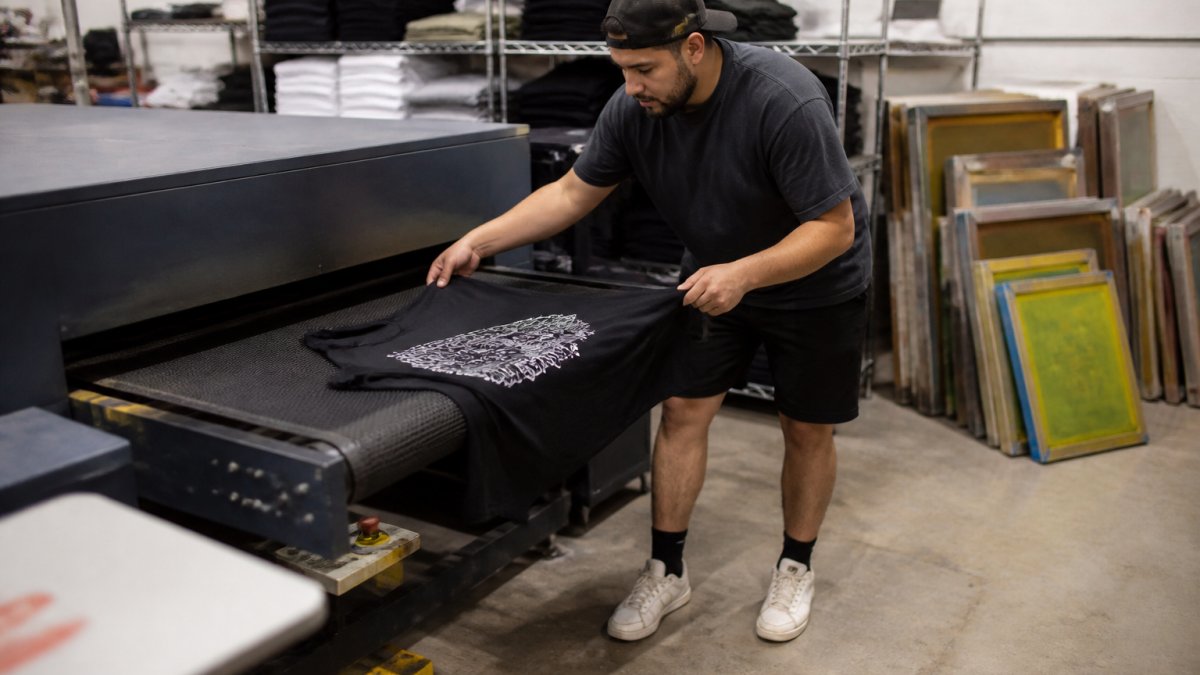
Rush custom t-shirt printing qualifies when three things line up: artwork is press-ready, the garments are in stock, and the shop has open capacity on the press. Miss any one of those and the deadline moves, regardless of what the method can theoretically do.
Watch out: out-of-stock apparel is the quiet killer. Underground Shirts' guidance on production timing notes that a backordered garment style can add days or weeks, and no amount of rush fees buys a shirt that isn't in the building.
What gets you into the rush queue:
- Vector artwork with fonts outlined and colors specified
- Blank styles the printer stocks in your sizes
- Written approval signed the same day you receive the proof
What pushes you out:
- Raster files, low-resolution logos, or screenshots of designs
- Specialty inks, oversized prints, or multi-location decoration
- Sizes split across five garment colors
Screen Printing vs DTG, Vinyl, and Embroidery for Urgent Jobs
Screen printing wins on urgent bulk orders, and it isn't close. Once screens are burned, the per-piece time drops sharply, which is why it dominates volume production.
| Method | Best For | Urgent-Job Reality | Setup Burden |
|---|---|---|---|
| Screen printing | Bulk orders, bold graphics | Fastest per-piece once set up | One screen per color |
| DTG | Small runs, photo detail | No screens, but slower per shirt | Digital file prep |
| Vinyl | Names, numbers, single pieces | Quick for tiny counts | Cutting and weeding time |
| Embroidery | Logos, uniforms, polos | Slower stitch-out and hooping | Digitizing file required |
The tradeoff is real. Screen printing carries setup cost that only makes sense at volume, while DTG handles full-color detail without screens but slows as quantities climb.
Kornit's 2026 screen printing outlook describes buyer demand shifting toward smaller quantities and faster delivery, which is exactly why shops now run mixed methods rather than one press for everything.
If you want to see how a finished screen-printed graphic reads on a soft tee, our Fathers Day Gift Worlds Okayest Dad Shirt Mens T Shirt shows the print clarity screen printing delivers on a detailed design.
Bulk Screen Printing Pricing and the Rush Cost Tradeoff
Bulk screen printing pricing falls as quantity rises, then rush fees push it back up. The fix is to price the same order twice, once standard, once rushed, and compare line by line.
Expect the per-unit price to drop sharply between 12 and 50 pieces, flatten past 100, then climb again with rush production. Rush fees appear as a percentage surcharge or flat expedite charge, covering overtime press time and bumped scheduling, not faster shipping.
Where the money actually goes:
- Screen charges - a one-time setup cost per color, not per shirt
- Garment cost - varies by blank style, blend, and size
- Print cost - scales down with quantity
Worked Scenario: 24 Pieces vs. 100 Pieces, Standard vs. Rush
Because published rush pricing varies so widely, model the structure rather than quote a single number. Most shops follow this pattern:
Total order cost = (screen charges) + (garment cost × quantity) + (print cost × quantity) + (rush surcharge) + shipping
Run that formula on two quantities and the tradeoff becomes obvious:
Personalized "The Man, The Myth, The Legend" T-Shirt – Father's Day Gift →
| Line item | 24-piece order | 100-piece order |
|---|---|---|
| Screen charges (one color) | Fixed, same dollar amount | Fixed, same dollar amount |
| Garment cost | Per unit, roughly flat | Per unit, often lower at volume |
| Print cost | Higher per unit | Lower per unit |
| Rush surcharge | Percentage of the order or flat fee | Same percentage or flat fee |
| Shipping | Similar | Similar, sometimes lower per unit |
The screen charge is the lever. On a 24-piece order it is spread across 24 shirts; on a 100-piece order, across 100. That is why a 24-piece rush order can cost more per shirt than a 100-piece standard order, setup cost divided by fewer units, not a markup trick.
The Rush Surcharge Is Not the Only Cost
Three costs hide behind the word "rush":
- Expedite fee - the queue-jump charge, usually a percentage of production or a flat fee per order.
- Overtime press time - some shops pass this through separately when your job runs after hours.
- Upgraded shipping - if the in-hands date is tight, you may pay for faster freight on top of the rush fee. Rush production does not include rush delivery unless the quote says so.
Buyers often approve a rush fee, then are surprised by a shipping upgrade costing as much as the fee. Confirm both before you sign.
When Paying the Rush Fee Is Worth It
Pay the expedite fee when the event date is fixed and missing it costs more than the premium, a tournament uniform order, a corporate event with a hard date, or a reorder keeping a retail display stocked.
Weighing value before you commit? Our Coolest Dad Ever Shirt Funny Shirts For Men shows what a finished custom print looks like at a mid-range price point.
The Artwork and Approval Checklist That Prevents Delays
Most missed deadlines are artwork problems wearing a scheduling costume. Run this checklist before you send anything to a printer:
- File is vector (AI, EPS, PDF) or a 300 DPI PNG at final print size
- All fonts converted to outlines or paths
- Colors specified as Pantone or exact hex values
That last box matters more than buyers think. A proof approved at 4 p.m. Friday often doesn't hit a press until Monday, and a three-day promise just became five.
Watch out: personalized name and number orders are the most common source of reprints, because a single transposed letter means the whole shirt is wrong.
Our Fathers Day Gift Papa Since 2015 Papa Shirt is a good example of the kind of custom name and text artwork that needs a careful proof review before it goes to press.

How to Choose a Fast Turnaround Printing Partner
Choose a partner by comparing written promises, not homepage banners. Ranking results are full of shops advertising "fast turnaround" and "same-day" without defining either, so force every provider onto the same scorecard.
The Turnaround Scorecard: Compare Like With Like
Ask every shop the same five questions and write the answers in the same units, business days, with a named cutoff time.
| Question | Why it matters | Red flag answer |
|---|---|---|
| What is the standard turnaround, in business days, from approved artwork to ship date? | Separates production time from shipping time | "Fast" or "quick" with no number |
| What is the daily cutoff for artwork approval to count as day one? | A 4 p.m. Friday approval may not start the clock until Monday | No stated cutoff |
| What specifically disqualifies an order from rush? | Quantity, garment stock, print locations, colors, specialty inks | "We can rush anything" |
| What is the rush surcharge in dollars, and is shipping included? | Rush production and rush delivery are different charges | Percentage only, no dollar figure |
| What happens if the order ships late? | Reveals whether the shop plans capacity or promises and hopes | No remedy offered |
That last row separates shops that plan capacity from shops that promise and hope. Any provider unwilling to put a rush cutoff time in writing is telling you something.
Same-Day Processing vs. Same-Day Production vs. Same-Day Delivery
The phrase "same-day" means three different things in this category, and the gap between them is where deadlines die:
- Same-day processing - your artwork and order are reviewed and entered the same day. Nothing is printed yet.
- Same-day production - the order is printed and inspected the same day, which usually requires artwork approved before the shop's morning cutoff and garments already in stock.
- Same-day delivery - the finished order reaches you the same day, which depends on local courier availability and is rarely offered outside a shop's immediate delivery zone.
When a provider says "same-day," ask which of the three they mean. A shop offering same-day processing but two-day production isn't lying, it is using the phrase loosely, and your event date is what's at risk.
The Shortlist Method We Would Use
- Request a written quote with the rush fee broken out separately, in dollars.
- Ask for the in-hands date, not the ship date.
- Confirm the blank style is in stock in your sizes today, a backordered garment can add days or weeks no matter what you pay for rush.
- Send a test file and time how long the proof comes back. Proof turnaround is a preview of production responsiveness.
- Ask what happens if the order ships late, and get the answer in writing.
Check the Shop's Own Process Against the Scorecard
Our own process: one business day to hand print and inspect your order, then two to three business days for shipping, with most orders leaving within one or two business days. If we can't hit 48 hours, we contact you directly rather than letting the deadline slide silently. Hold every provider to the same standard, a stated cutoff, a stated disqualifier list, a stated rush fee in dollars, and a stated remedy for a late shipment.
Place Your Rush Order and Lock In Your Date
The gap between a smooth rush order and a missed event comes down to preparation, not luck. Lock your artwork, confirm your blanks, approve fast, and get the in-hands date in writing.
At eBollo.com, we have over 20 years of experience and offer custom screen printing for orders of all sizes. Start with our Personalized "The Man, The Myth, The Legend" T-Shirt or the Customized Shirt The Man The Myth The Legend Personalized Shirt and get your date locked in today.


Frequently Asked Questions
How long does screen printing actually take?
Provider timelines vary widely. One provider advertises rush jobs finished in 2 to 3 business days, with delivery as fast as same day to two business days in some cases, while MFG Merch reports an average of about 14 working days for U.S. contract screen printers. Most eBollo orders ship within one or two business days. Ask any printer for production and shipping separately before you commit to a date.
What determines whether a rush custom t-shirt printing order qualifies?
Four things decide it: whether your blanks are in stock, whether your artwork is print-ready, your order quantity against the shop's production capacity, and how many ink colors and print locations the design uses. Underground Shirts notes out-of-stock apparel can add days or weeks, and artwork approval and design complexity also affect timing. A 500-piece order on backordered garments may face delays.
How does bulk screen printing pricing change for a rush order?
Screen printing has setup costs per color, so the per-shirt price drops as quantity rises. Rush work usually adds a premium because the shop reschedules other jobs or runs overtime. For bulk jobs, ask for the per-unit price at your exact quantity and get the rush fee quoted as a separate line so you can compare providers on the same basis.
Is same-day screen printing realistic for a large corporate order?
Rarely. Same-day and next-day service exists for small runs of in-stock garments with simple designs, but large corporate orders need screens burned, shirts pulled, printed, cured, and packed. Every added color and size break adds time. If your event is weeks out, standard production is safer and cheaper. If it is days out, confirm stock on your specific sizes first, then ask what quantity the shop can genuinely finish in your window.
How do I avoid delays and get high-quality prints on a tight deadline?
Send vector artwork or a 300 DPI file at final print size, approve the digital proof the same day it arrives, and confirm your garment sizes and colors are in stock before you pay. Keep the design to a manageable color count, since each screen adds setup time. Ask for a written production date and shipping date. eBollo hand-prints shirts to order and will contact you directly if an item cannot be sent within 48 hours.
Your deadline is the one thing in this process you can't negotiate after the fact. Send us your artwork and in-hands date, and we will tell you honestly whether it fits our press schedule before you pay a rush fee. Get started with eBollo.com and put a confirmed production date on your next custom order.


